
The Shah Bano Case: One Woman, One Petition, and a Storm That Changed India
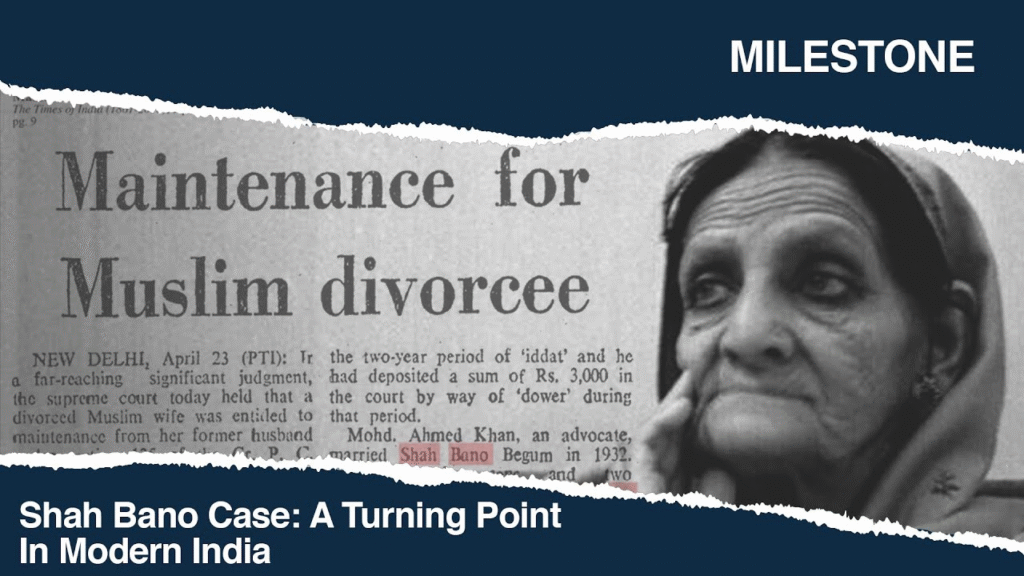
If you’ve ever wondered how one court case can shake an entire nation, spark heated debates, and rewrite laws — the Shah Bano case is the ultimate example. It has drama, courage, politics, religion, and a simple yet powerful question:
“Does every woman in India have the right to maintenance, no matter her religion?”
The Woman Behind the Case
Shah Bano wasn’t a celebrity, activist, or politician.
She was a 62-year-old mother of five from Indore, who, after being divorced by her husband through triple talaq, was left with almost nothing.
Most people in her position would have accepted their fate quietly.
But Shah Bano didn’t.
Instead, she walked into court and said — “I deserve justice.”
And that’s where the story truly begins.
Why Her Fight Mattered
At the heart of the case was Section 125 of the Criminal Procedure Code, a simple law meant to prevent any deserted spouse from falling into poverty.
But the twist? Shah Bano was a Muslim woman.
The question was — Does Section 125 apply to Muslim women too?
Her husband argued that Muslim personal law governed the matter, not the CrPC.
The court now had to decide: Uniform law or religious law? Constitutional rights or personal rules?
The whole country held its breath.
The Landmark Verdict (1985)
The Supreme Court stepped in and delivered one of the boldest judgments in Indian legal history.
It said:
- Yes, Muslim women ARE entitled to maintenance under Section 125.
- Yes, dignity and equality rise above personal law.
This wasn’t just a verdict. It was a message — Indian women, regardless of religion, cannot be denied their right to basic support.
The judgment sparked celebrations… and controversy.
Politics, Protests, and a New Law
The reaction was explosive.
Some groups felt the judgment interfered with religious freedom. The government, fearing backlash, passed the Muslim Women (Protection of Rights on Divorce) Act, 1986, which diluted the Supreme Court’s judgment.
And suddenly — a fight that began in one family turned into a nationwide debate on secularism, women’s rights, and the future of Indian law.
Why the Case Still Matters Today
Even decades later, the Shah Bano case isn’t just history. It’s a mirror.
It shows us:
- how a legal system struggles between equality and tradition
- how a single woman can challenge an entire structure
- how law evolves with society
The case also laid the foundation for later reforms like the judgment banning instant triple talaq in 2017.
Shah Bano may no longer be with us, but her courage set off a chain reaction India is still talking about.
The Legacy
At its core, the Shah Bano case is not just a legal debate — it’s a human story.
A story of:
- standing up against injustice
- speaking truth to power
- and reminding the world that even the quietest voices can spark the loudest revolutions
Shah Bano didn’t just win a case.
She started a conversation that changed India forever.
